Home / Outdoor living / Front yards
10 Front Yard Ideas for Southern California Homes That Use Less Water
Ways to give your house more curb appeal with less lawn, from a planted entry path to a small courtyard by the front door, plus what to check before you build.
By the American Home editorial team
- Replacing some or all of a lawn with low-water plants, gravel and stone changes how a front yard looks more than any other single project.
- Group plants with similar water needs and water them with drip lines instead of spray heads.
- Many Southern California water agencies offer rebates for replacing a lawn, but you have to apply before you remove the grass.
- Check your city’s rules before you build a front-yard fence or wall. In Los Angeles, taller fences in the front yard need a Zoning Administrator’s approval.
The front yard is the first thing people see, and in most Southern California neighborhoods it is also the part of the property that gets the least use. That makes it a good place to save water and add character at the same time. These ideas work for Spanish, Craftsman, ranch and modern homes, and most of them can be done in stages.
1. Swap part of the lawn for a planted garden
You don’t have to remove every blade of grass. Start with the strip along the street or the corners of the yard, and replace them with layered planting: a few shrubs for structure, grasses for movement and low groundcovers to fill in. Sages, manzanita, lavender, rosemary and deer grass all handle Southern California summers well once they are established.
Good to know: Many water agencies in the region pay rebates for replacing a lawn through SoCal Water$mart. The rules require plants, a way to hold rainwater and no spray sprinklers, and you must apply before you start.
2. Make the path to the door the centerpiece
A wide, clear path tells visitors where to go and gives the whole yard a shape. Flagstone set in gravel, decomposed granite with a steel edge, or pavers laid with gaps all let rainwater soak in instead of running into the street. Make the path wide enough for two people to walk side by side, and plant right up to its edges so it feels like part of the garden.
3. Add a small courtyard by the entry
A few square feet of gravel or pavers next to the porch, with two chairs and a pair of large pots, turns a pass-through space into a place to sit. It suits Spanish and Craftsman homes especially well, where a courtyard feels like an extension of the architecture.
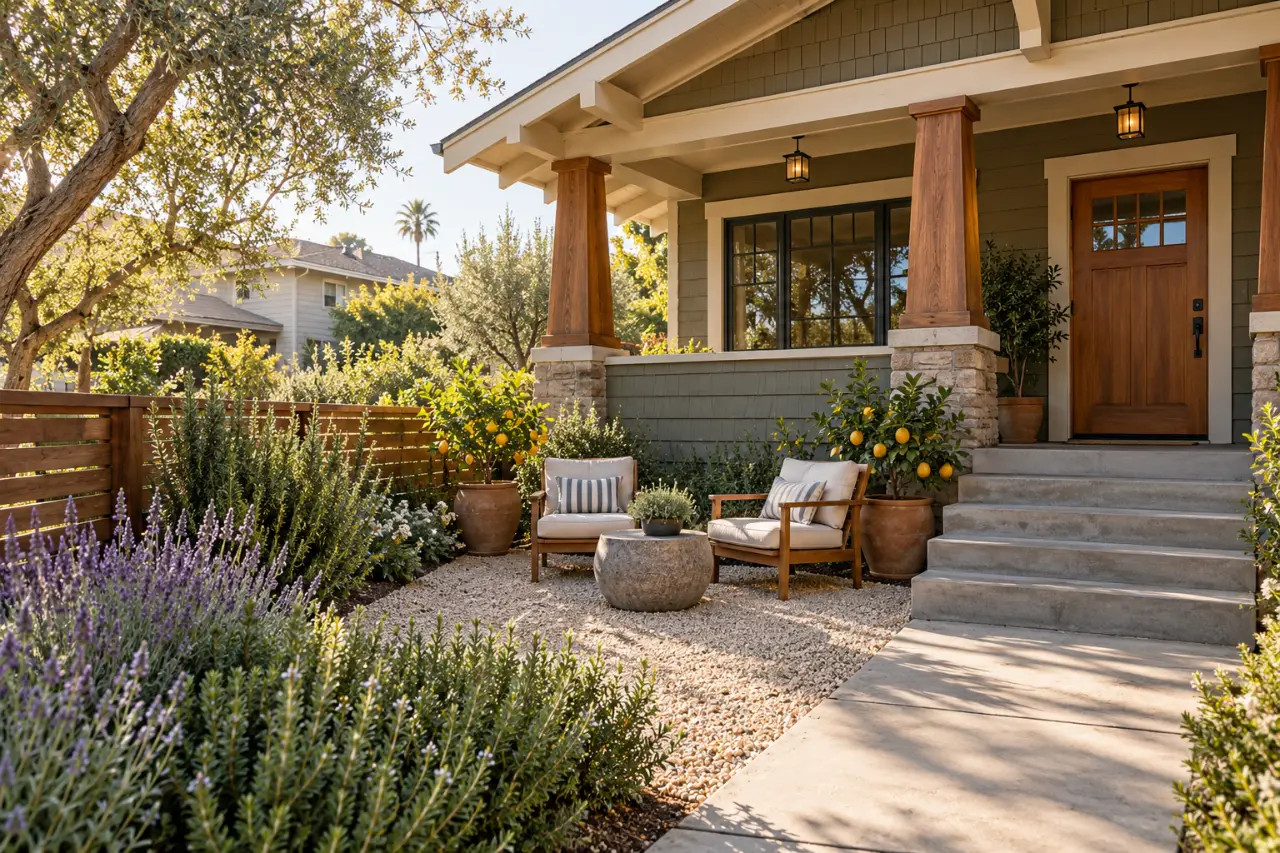 Design concept
4. Define the yard with a low wall or planter
A low stucco wall or a raised planter that matches the house gives the yard an edge, holds soil for planting and adds a place to sit. Keep it low enough to stay friendly to the street. Fence and wall heights in front yards are limited by local zoning: in Los Angeles, fences and walls taller than the rules allow need a Zoning Administrator’s approval after a public hearing.
5. Plant one strong tree
A single well-placed tree does more for curb appeal than a row of small shrubs. It shades the front of the house, frames the entry and softens the roofline. Choose a drought-tolerant tree that fits the space when it is fully grown, and keep it a safe distance from the house, the driveway and any sewer line.
6. Build a dry creek bed for winter rain
A shallow channel lined with river rock and a few boulders can carry rain from a downspout into a planted area, where it soaks into the soil. It looks good in the dry months, too. A stormwater feature like this is also one of the requirements for lawn replacement rebates.
7. Match the planting to the style of the house
- Spanish and Mediterranean. Terracotta pots, olive trees, rosemary, lavender and agave against white stucco.
- Craftsman. Native shrubs, flagstone, wood accents and a softer, looser layout.
- Ranch. A mix of grasses and flowering perennials along a long, low facade, with a simple path.
- Mid-century and modern. Gravel, bold sculptural plants, clean lines and a limited palette of two or three plant types repeated.
8. Light the path, not the whole yard
A few low path lights and one light on the house number or the tree are usually enough. Warm white light looks more natural than cool white and is easier on the neighbors. Low-voltage systems are simple to add later if you run a conduit while the yard is open.
9. Screen the trash bins and utilities
Bins, meters and air conditioning units pull attention away from the house. A short slatted screen or a few dense shrubs can hide them while keeping access clear for collection day and meter readers.
10. Plan the first five feet around the house
If your home is in a fire hazard zone, keep the area right next to the walls lean: stone or gravel instead of wood mulch, and no dense plants under windows or eaves. Our guide to Zone 0 and fire-resistant homes explains what the state’s proposed rules would mean for that space.
Before you start
- Check for rebates first. If you are replacing a lawn, apply through SoCal Water$mart or your water agency before you remove any grass.
- Pick plants for your area. Calscape, the California Native Plant Society’s gardening site, has a garden planner and a search for native plant nurseries near you.
- Take a free class. Los Angeles County’s Smart Gardening program runs free webinars and workshops on water-wise gardening.
- Check fence and wall rules with your city before you build anything along the front property line.
- Hire licensed help for the hard parts. Irrigation, grading and stone work are worth a professional. Check the contractor’s license before you sign.
Frequently asked questions
What can I plant instead of a lawn in Southern California?
Low-water shrubs, grasses and groundcovers, many of them native to California. Combine a few larger plants for structure with smaller ones in between, and use mulch to cover the soil while they fill in.
Do I need a permit to redo my front yard?
Planting usually doesn’t need one, but walls, fences, new electrical work and changes to the driveway often do. Height limits for front-yard fences and walls depend on your city and zone, so check before you build.
Will a water-wise yard look dry?
Not if it is planned well. Evergreen shrubs keep the yard green all year, grasses and flowering plants add color through the seasons, and mulch keeps the ground looking finished while plants grow.
Rules and rebate programs change. Check with your city and water agency before you start. This article is general information, not legal advice.
Planning a front yard makeover?
Tell us about your project. We will help you understand your options and connect you with licensed local contractors who may be a good fit.
By submitting, you agree that we may contact you and share your project details with licensed contractors in our network. See our Privacy Policy.