Home / Outdoor living / Fire safety
Fire-Resistant Landscaping: Plants and Layout for Southern California Yards
No plant is fireproof, but the right plants, spacing and upkeep make a yard much harder for embers and flames to cross. Here is how to plan one.
By the American Home editorial team
- No plant is fireproof. Leaf moisture, low growth and regular cleanup matter more than any “fire-safe” label.
- Plan the yard in zones: a nearly bare first five feet, clean and well-spaced plants out to 30 feet, and thinned vegetation out to 100 feet.
- California’s statewide Zone 0 rule for the first five feet is not in force. It was withdrawn from state review on September 8, 2026, and had not been refiled as of October 16.
- Defensible space from 5 to 100 feet is already enforceable in many high-risk areas, and Los Angeles requires brush clearance up to 200 feet in its Very High Fire Hazard Severity Zone.
Southern California yards are planted for sun, shade and low water use. In fire country, they also need a plan for embers. The good news is that a fire-resistant yard can still be green and comfortable. It comes down to three things: which plants you choose, where you put them, and how well you keep them up.
What makes a plant more fire-resistant
Start with an honest baseline. University of California Master Gardener writers put it plainly: all plants can burn, however they are marketed. What differs is how easily a plant catches and how hot it burns.
- Moisture helps. Plants with more water in their leaves are slower to ignite. Succulents are a common example.
- Oils, waxes and resins hurt. Resin-rich plants, including many conifers, burn readily.
- Shedding adds fuel. Plants that drop bark, branches or needles, such as eucalyptus, leave litter that needs regular cleanup.
- Dense, twiggy growth can trap embers. Open, airy plants give embers less to catch on.
Being native does not by itself make a plant safer or riskier. Upkeep often matters more than species: a watered, pruned shrub is a smaller risk than a neglected “fire-resistant” one full of dead wood.
Good to know: Treat any plant list as a starting point, not a guarantee. UC Master Gardener writers caution that calling a plant fire-resistant oversimplifies a complex problem.
Plan the yard in zones
Fire agencies divide the space around a home into zones measured out from the walls. Each zone has a different job.
- Zone 0, 0 to 5 feet: the ember-resistant zone. Hard, noncombustible surfaces and no wood mulch.
- Zone 1, 5 to 30 feet: clean, well-spaced plants, no dead material, and branches kept away from the roof and chimney.
- Zone 2, 30 to 100 feet: less fuel overall. Annual grass is cut to 4 inches or less, and shrubs and trees are spaced apart.
Zones 1 and 2 are not new. In many high-risk areas they are enforceable now under California Public Resources Code 4291 and Government Code 51182. Cities can add their own rules on top, and Los Angeles does (see below).
The first five feet: hardscape first
Guidance from the California Governor’s Office of Emergency Services (Cal OES) for its home-hardening program calls for clearing all vegetation within five feet of the home, including under decks. It also calls for removing wood chips, bark, other combustible mulch and synthetic lawn, then laying a permeable weed barrier topped with gravel.
A statewide Zone 0 rule would set similar requirements for many homes. The Board of Forestry adopted it on August 19, 2026, then withdrew it from state review on September 8 before it took effect. As of October 16, 2026, it had not been refiled, so no statewide Zone 0 deadline is running. Local agencies can still adopt their own rules. Our Zone 0 explainer covers the details.
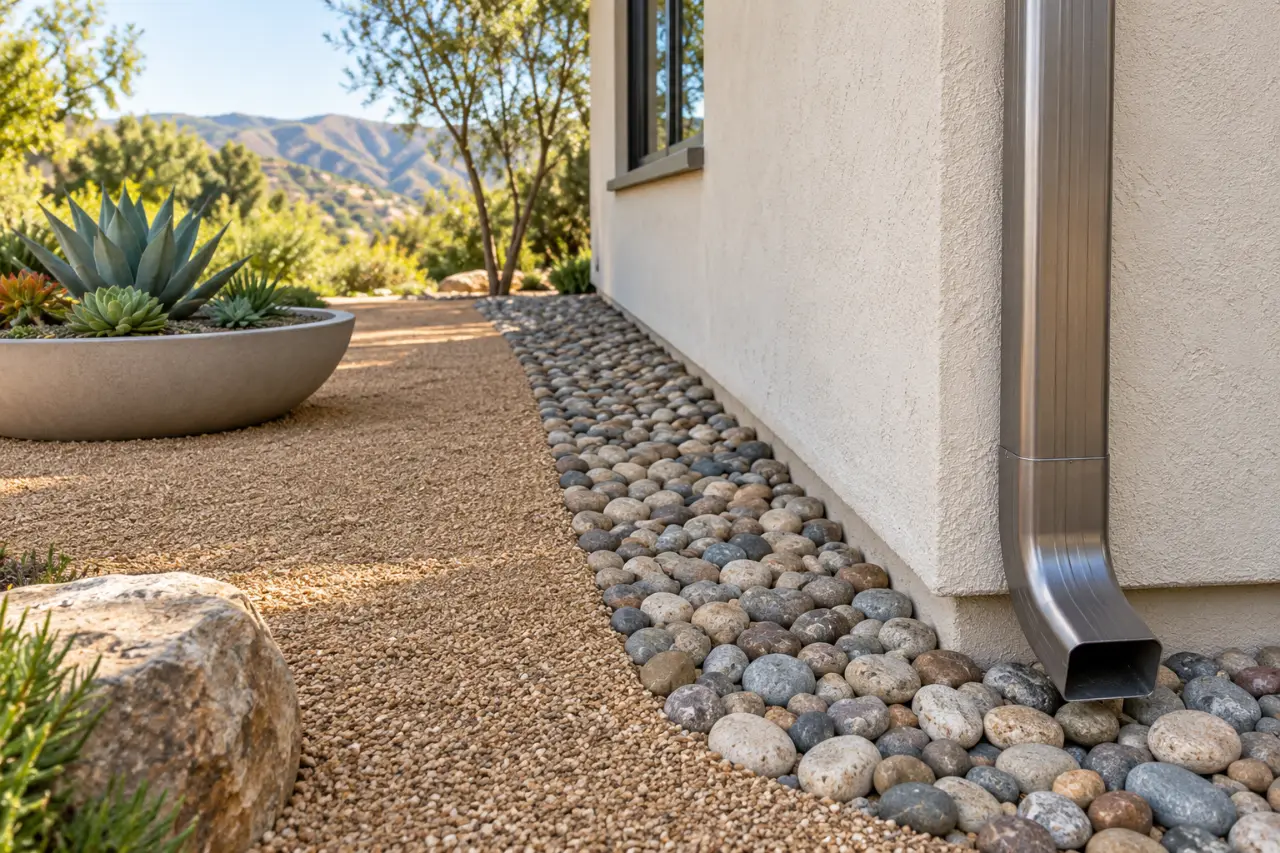 Design concept
Good to know: A band of gravel or pavers along the walls is the simplest Zone 0 layout. Start planting where that band ends.
Plants that tend to resist fire in Southern California
Low, moist, open plants are generally the safer choice beyond the first five feet. A Fine Gardening guide to fire-resistant plants for Southern California suggests options like these:
- Ground covers: ‘Low Boy’ prostrate acacia, creeping myoporum, silver carpet (Dymondia) and low ceanothus such as Hearst’s ceanothus. They hug the ground and offer little fuel.
- Small fillers: wall germander and low thymes, useful for separating bulkier plants.
- Succulents: their high water content makes them slow to ignite.
- Shrubs: California lilac (ceanothus), which took more than 60 seconds to ignite in a direct-flame test at Las Pilitas Nursery, and smaller buckwheats, which burned very slowly.
- Trees: desert willow and strawberry tree, which have open crowns, and oaks, whose thick bark slows heat.
The same guide advises against conifers as tall shade trees, because their needles and resin burn readily. Keep heavy shedders away from the house, too.
Good to know: Plants stay fire-resistant only when they are watered and cleaned up. UC Master Gardener writers stress regular irrigation and removing dead leaves and plants.
Spacing and layout
Fire travels along continuous fuel. Instead of solid hedges and wall-to-wall beds, plant in separate islands and break them up with paths, gravel or pavers.
Watch for ladder fuels, the plants that let fire climb from the ground into trees. UC guidance gives an example: a 5-foot shrub near a tree needs about 15 feet of clearance to the tree’s lowest branches. On slopes, leave more room, because fire moves uphill quickly. Cal OES program guidance describes clearances between retained shrubs and trees of roughly 4 to 40 feet, depending on slope, plant size and type.
In the City of Los Angeles Very High Fire Hazard Severity Zone, the Los Angeles Fire Department (LAFD) sets specific rules for vegetation within 200 feet of structures:
- Trees taller than 18 feet must be trimmed so no foliage is within 6 feet of the ground.
- Trees and shrubs under 18 feet must have lower branches removed to one-third of their height.
- Individual native shrubs can stay if they are at least 18 feet apart, trimmed and free of dead material.
- Grass and native brush must be cut to 3 inches.
Mulch, upkeep and the roof line
LAFD rules also cover the roof. Keep it free of built-up leaves, needles and twigs, keep 5 feet of vertical clearance between the roof and overhanging branches, and keep foliage at least 10 feet from a chimney outlet.
Mulch needs care. LAFD allows chipped material to be spread up to 3 inches deep within 30 feet of structures and up to 6 inches deep beyond that, but not within 10 feet of a usable roadside. Within the first five feet of the house, Cal OES guidance removes combustible mulch altogether.
Do brush work safely. LAFD prohibits brush clearance on red flag days and requires non-sparking cutting blades and a fire extinguisher or charged garden hose within 10 feet of the work.
A simple plan for an existing yard
- Ask your local fire agency whether your home is in a high-risk zone and which rules apply.
- Clear the first five feet: remove plants, mulch and stored items, and lay gravel or pavers.
- Remove dead plants and limb up trees and shrubs.
- Replace resin-heavy or heavy-shedding plants near the house with low, moist ones.
- Keep drip irrigation working so plants stay hydrated.
- Walk the yard again before fire season and after big storms.
Larger changes, like new hardscape or regrading a slope, are good projects for licensed local contractors. Our guide on how to check a contractor license in California shows how to confirm a license before you hire.
Frequently asked questions
Are there plants that will not burn?
No. All plants can burn. Some ignite more slowly because they hold more moisture or grow low and open, but upkeep and spacing matter as much as the plant you pick.
Is gravel or artificial turf better next to the house?
Gravel. Cal OES home-hardening guidance removes synthetic lawn, wood chips and bark from the first five feet and uses gravel over a permeable weed barrier instead.
Do I have to follow Zone 0 rules now?
Not statewide. The Zone 0 rule was withdrawn from state review in September 2026 and had not been refiled as of October 16, 2026. Defensible space from 5 to 100 feet, and LAFD brush clearance where it applies, are already required.
This article explains published guidance for homeowners and is not legal advice. Fire rules can change, especially while the state Zone 0 rule is pending. Check with your local fire agency.
Sources
The Zone Zero Report: Zone 0 updates (checked October 19, 2026)
California Defensible Space: Zone 0 rule status (checked October 19, 2026)
Cal OES: Defensible space, Zones 0, 1 and 2 (September 2025)
Los Angeles Fire Department: Brush clearance requirements
UC Master Gardeners (UC ANR): Fire-wise landscaping notes
Fine Gardening: Choosing fire-resistant plants in Southern California
Planning fire-safe landscaping?
Tell us about your project. We will help you understand your options and connect you with licensed local contractors who may be a good fit.
By submitting, you agree that we may contact you and share your project details with licensed contractors in our network. See our Privacy Policy.